
Eleanor Cross Geddington
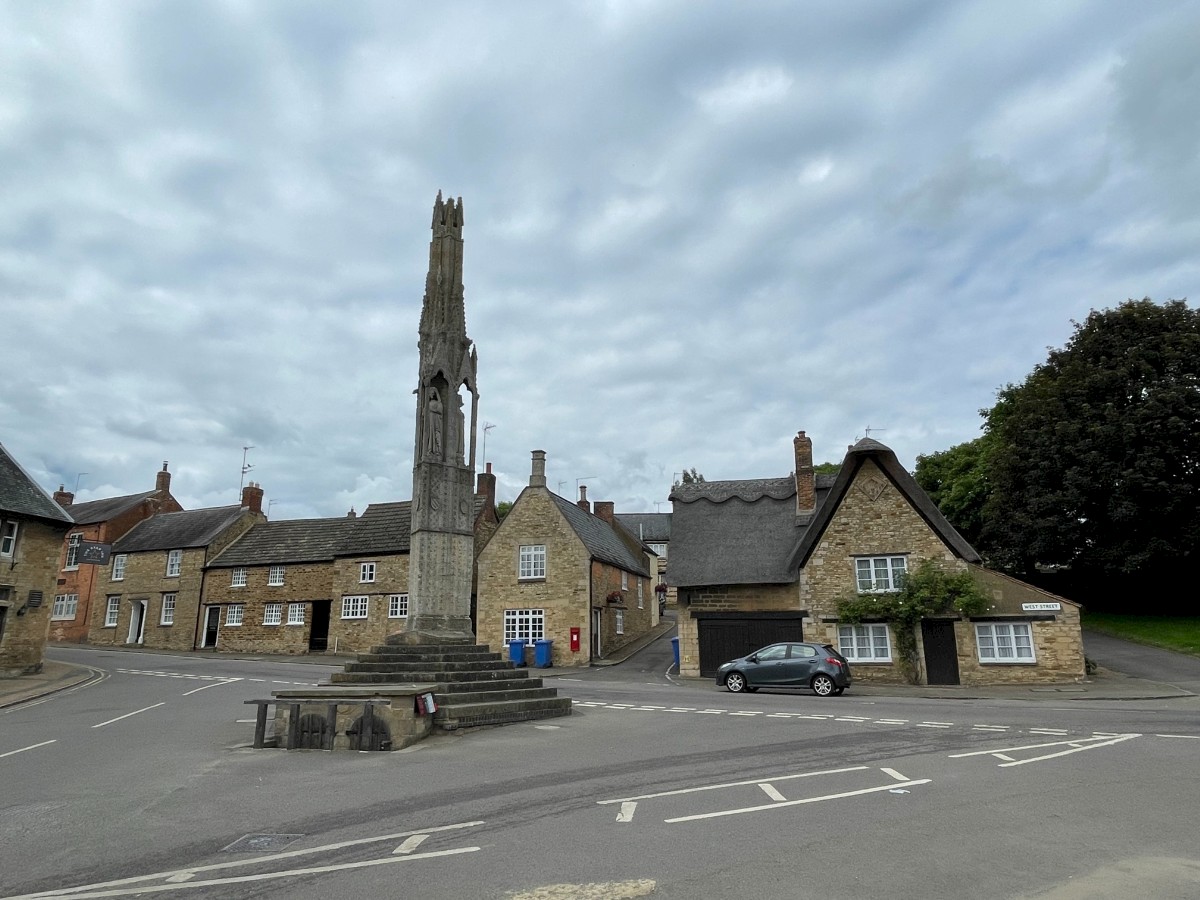
The Eleanor crosses were a series of twelve tall and lavishly decorated stone monuments topped with crosses erected in a line down part of the east of England. King Edward I had them built between 1291 and about 1295 in memory of his beloved wife Eleanor of Castile. The King and Queen had been married for 36 years and she stayed by the King’s side through his many travels. While on a royal progress, she died in the East Midlands in November 1290. The crosses, erected in her memory, marked the nightly resting-places along the route taken when her body was transported to Westminster Abbey near London.
The crosses stood at Lincoln, Grantham and Stamford, all in Lincolnshire; Geddington and Hardingstone in Northamptonshire; Stony Stratford in Buckinghamshire; Woburn and Dunstable in Bedfordshire; St Albans and Waltham (now Waltham Cross) in Hertfordshire; Cheapside in London; and Charing (now Charing Cross) in Westminster.
Three – those at Geddington, Hardingstone and Waltham Cross – survive more or less intact; but the other nine, other than a few fragments, are lost. The largest and most ornate of the twelve was the Charing Cross.
Eleanor's bier spent the night of either 6 or 7 December 1290, or possibly both, in Geddington, Northamptonshire. The master mason for the cross here is not known: it was probably constructed in 1294 or 1295. It was recorded by William Camden in 1607; and still stands in the centre of the village, the best-preserved of the three survivors. It is unique among the three in having a triangular plan, and a taller and more slender profile with a lower tier entirely covered with rosette diapering, instead of the arch-and-gable motif with tracery which appears on both the others; and canopied statues surmounted by a slender hexagonal pinnacle.